Blogs /
Marketing Strategy
As travel demand evolves, hotel marketing is no longer just about visibility—it’s about being discovered where booking decisions are made. This report explores how search, social, and AI are reshaping guest acquisition.
By Shahar Rubin, Co-founder

I use AI sentiment analysis to turn guest comments into a fix list - not just a score. My starting point: choose 1 repeated complaint, check the original feedback, and assign someone to resolve it.
Here’s the approach I follow:
Sort feedback by topic: Separate praise for staff from complaints about rooms, noise, or billing.
Set priorities: Weigh frequency, severity, and urgency. Route urgent complaints for staff review.
Test before launch: Check data access, costs, language support, and accuracy. Limit access to guest information.
Keep people in charge: Review AI results before taking action that affects a guest.
Check results: Track repeat complaints and completed fixes. Use verified praise in marketing, then test whether the copy helps direct bookings.
The goal is better decisions, not more reports. I check feedback counts alongside sentiment scores - and measure AI-powered booking results rather than assume a happier guest means more revenue.
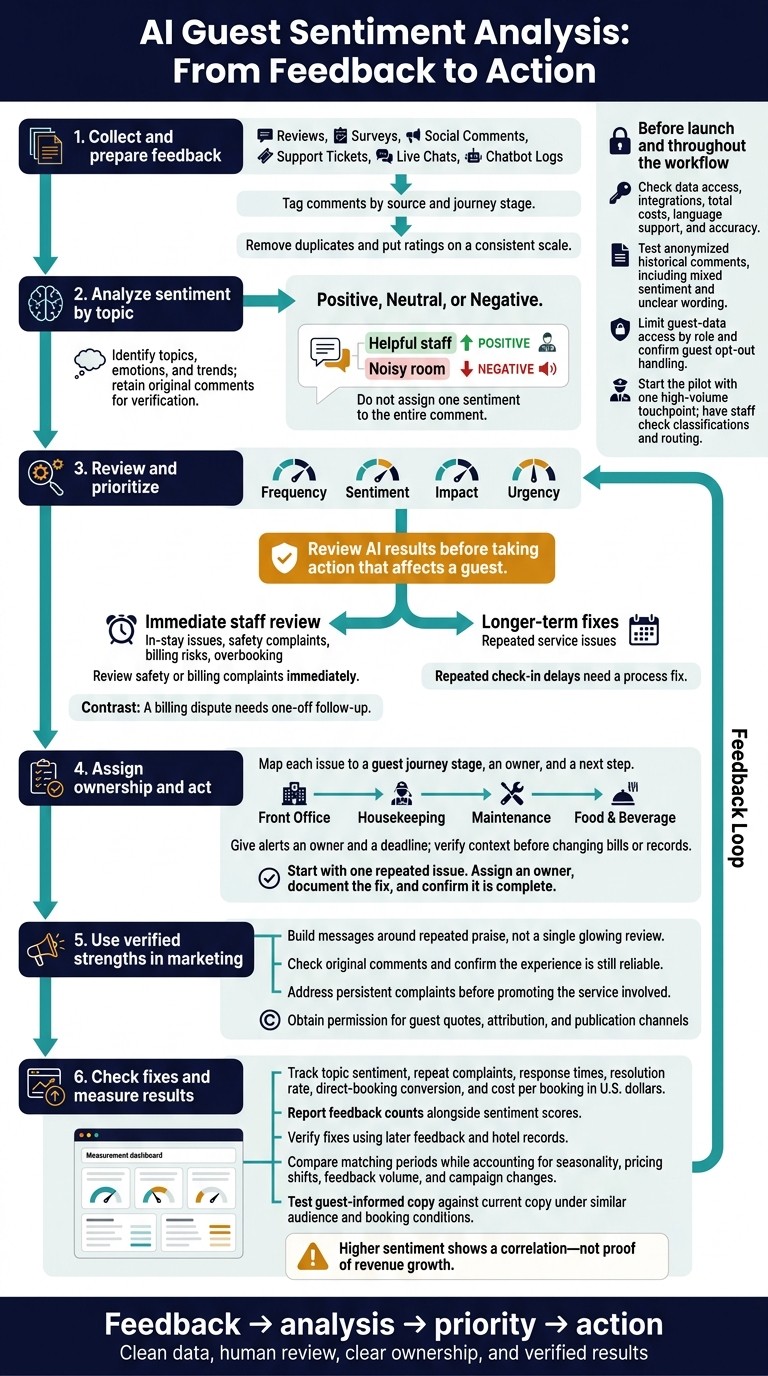
AI Guest Sentiment Analysis: From Feedback to Action
How AI Analyzes Guest Feedback
Collect and Prepare Guest Comments
Bring reviews, surveys, social comments, support tickets, live chats, and chatbot logs into one place. Tag each comment by source and hotel customer journey stage so teams can trace it to the right touchpoint. Before analysis, remove duplicates and put ratings on a consistent scale.
Classify Sentiment in Context
NLP analyzes wording and context - not just keywords. Most tools label comments as positive, neutral, or negative. Some also score sentiment intensity and confidence.
A mixed comment about helpful staff and a noisy room needs aspect-based analysis: one sentiment for staff, another for noise.
Sarcasm and long threads can trip up models. Human review should come before final decisions.
Identify Topics, Emotions, and Trends
Topic detection groups feedback by issue, such as noise. Emotion detection can flag feelings ranging from frustration and confusion to relief and enthusiasm. Summarization condenses large sets of comments into brief themes.
Track sentiment for each topic over time and across channels. That way, a single overall score won’t hide recurring problems. Keep the original comments so teams can check the analysis.
Real-World NLP Project: Analyzing Hotel Reviews Step by Step
Use Guest Insights to Set Hotel Priorities
Once AI identifies themes, turn those findings into priorities, owners, and response rules.
Map Issues and Strengths to Teams and Journey Stages
Map each issue to a stage in the guest journey, an owner, and a next step. Then route it to the right team: front office, housekeeping, maintenance, or food and beverage. Compare properties or guest groups only when sample size and coverage support the comparison.
Next, rank the findings by impact.
Choose Metrics to Guide Improvements
Use metrics to decide what to fix first, but treat frequency, sentiment, impact, and urgency as separate signals. A common complaint deserves a closer look. Frequency alone, though, doesn't tell you how severe it is. Use these measures together, keeping in mind that scoring methods vary by tool.
Metric | Definition | Question Answered |
|---|---|---|
Aggregate sentiment score | Overall sentiment across sources | How do guests feel about the brand overall? |
Mention volume | Topic frequency | How often does this issue appear? |
Topic positivity | Sentiment for one topic | Where are guests satisfied or disappointed? |
Impact score | Link between topic sentiment and overall rating | Which topics are most associated with lower ratings? |
Priority score | Tool-ranked fix priority | Which fix should we review first? |
When comparing periods, use the same sources, categories, and scoring method. Check sample size and seasonality before calling a change progress. Pair topic scores with logs, wait times, or defect reports to confirm whether a fix worked.
Separate Urgent Complaints From Repeated Issues
After ranking issues, separate complaints that need immediate escalation from those that need longer-term fixes. Alert staff to in-stay issues, safety complaints, billing risks, and overbooking. Review safety or billing complaints immediately.
Give each alert an owner and a deadline so it doesn't sit unanswered. Verify the context before changing bills or records.
Example: A billing dispute needs one-off follow-up; repeated check-in delays need a process fix.
Set Up Sentiment Analysis for Your Hotel
Check Data Access and Tool Features
Once you’ve chosen the model, build your hotel’s workflow around it. Confirm which reviews, social mentions, emails, chats, and support tickets you can access. Ask vendors to verify integrations, support for your guests’ languages, aspect-level sentiment analysis, real-time alerts, and access controls. Check total costs, including setup and usage fees, before committing.
Before connecting live feedback, test the tool on anonymized historical comments. Include mixed sentiment, unclear wording, and the languages your guests use. Make sure it scores each topic separately, rather than assigning only one score to the whole comment.
After testing, define who owns each issue and how staff should respond before going live.
Assign Categories, Owners, and Response Rules
Create a shared category guide for rooms, cleanliness, staff, location, dining, and billing. Give each category a primary owner and a backup. Document when to escalate urgent, repeated, and unresolved complaints.
Start the pilot with one high-volume touchpoint before expanding. Have staff check classifications and routing, then log each issue, action, and outcome. Use later feedback and hotel records to confirm that the fix worked.
Check Accuracy and Protect Guest Privacy
Capability | Hotel Benefit | Main Risk | Required Control |
|---|---|---|---|
Automated triage | Reduces manual sorting | Sarcasm or unclear wording gets mislabeled | Check flagged results against original comments |
Aspect-based analysis | Sorts feedback into consistent service categories | Mixed sentiment or long conversations lose context | Review multi-topic comments manually |
Multilingual analysis | Covers more guest languages | Idioms and cultural cues are misunderstood | Test historical comments in each major guest language |
Real-time alerts | Helps staff intervene quickly | Too many alerts for routine service issues | Calibrate for hospitality-specific context |
Require human review before any action that affects a guest. Build privacy controls into the workflow: limit guest-data access by role to what staff need, and confirm how guest opt-outs are handled before launch.
Keep checking labels during the pilot, especially when staff disagree. Once the workflow is stable, use the findings to guide guest-facing messaging and measure the impact on direct hotel bookings.
Apply Guest Insights to Marketing and Track Results
Turn the strongest verified themes in guest feedback into marketing copy.
Use Guest Praise in Campaign Messages
Build website copy and campaign themes around repeated praise, not a single glowing review. First, check the original comments and confirm that guests can still count on that experience. Address persistent complaints before promoting the amenity or service involved.
Before publishing a guest’s words, get permission for the quote, attribution, and channels where you plan to use it. Check whether you’re allowed to contact the guest for this purpose, and respect requests to stop communication. Keep the approved quote and permission record together.
Measure Guest Experience and Direct Bookings to increase hotel direct bookings
Once the message goes live, track whether guest sentiment and bookings move together.
Monitor topic sentiment, repeat complaints, response times, resolution rate, direct-booking conversion, and cost per booking in U.S. dollars. Report feedback counts alongside sentiment scores so changes in volume remain visible.
Compare matching reporting periods, accounting for seasonality, pricing shifts, feedback volume, and campaign changes. Test guest-informed copy against your current copy with similar audiences and booking conditions. Higher sentiment shows a correlation - not proof of revenue growth - unless a controlled test links the messaging to the change in bookings.
Conclusion: Turn Guest Feedback Into Action
Once you’ve analyzed and prioritized guest feedback, put it to work: feedback → analysis → priority → action. AI can flag topics and patterns, but hotels still need clean data, human review, and clear ownership to act on them.
Start with one repeated issue. Assign an owner, document the fix, and confirm it’s complete. Check later feedback before tackling more issues, and track progress through fewer repeat complaints and completed fixes. Use verified strengths in your marketing to support direct bookings - but measure revenue gains instead of assuming them.
FAQs
How much guest feedback do I need to spot reliable trends?
A single snapshot of reviews won’t show a reliable trend. Track sentiment consistently over time so you can act on it. Feedback also needs to represent your guests: if only dissatisfied guests respond, the trends may be misleading.
Don’t base service decisions on very small monthly samples. In the case study, about 56 responses per property per month was considered:
“dangerously thin”.
How can I tell if my sentiment analysis is accurate?
Choose tools that use natural language processing and machine learning, rather than basic keyword matching. Check whether they misread sarcasm, irony, or nuances tied to a guest’s background.
Keep your data clean and check for response bias - for example, feedback that comes only from dissatisfied guests. No AI is perfect. Use sentiment scores to spot trends and prioritize queues, not to make irreversible decisions about individual interactions without human validation.
How soon should I expect results from guest-feedback fixes?
Timing depends on how the tools are put to use. Real-time AI tools can flag individual issues immediately, giving staff a chance to step in. Sentiment analysis can show broader patterns in day-to-day operations once enough data has been collected. For complex systems like revenue management, results typically emerge in 4 to 8 weeks. After corrective action, you can expect measurable gains in guest satisfaction scores or sentiment recovery within 90 days.
Related Blog Posts
Share:
20 years of hospitality lessons. No fluff. No spam
Join 500+ hospitality pros getting our best growth playbooks.

hi@sailtech.ai
RESOURCES
Products
Free Tools
© 2026 Sail. All rights reserved.