Blogs /
Marketing Strategy
As travel demand evolves, hotel marketing is no longer just about visibility—it’s about being discovered where booking decisions are made. This report explores how search, social, and AI are reshaping guest acquisition.
By Shahar Rubin, Co-founder

I’d start with 1 sharing challenge, 1 reward, and 1 direct-booking goal - not a full program rollout. Points and badges can prompt participation, but I’d judge the pilot by added bookings after reward costs and staff time, not likes alone.
Here’s the approach I’d use:
Set a baseline: Record bookings, repeat stays, referrals, and reward claims before the test.
Keep rules clear: Make sharing optional, explain data use, require disclosure of rewarded posts, and check claims before issuing rewards.
Connect the booking path: Track referral links and campaign tags, including Sail campaign traffic, separately from reward eligibility.
Measure the return: Compare results with a similar guest group and count rewards, ads, setup, and staff time.
My rule: <u>sharing is not a booking</u>. I’d expand only when the pilot brings in added direct bookings that cover its costs.
Plan Rewards and Sharing Challenges
Give each reward one business purpose - direct bookings, repeat stays, or referrals - and one qualifying action. Before launch, publish who qualifies, reward values, expiration dates, and claim steps. Verify completed stays, including referred guests’ stays, before issuing rewards. Favor rewards for actions that can lead to direct bookings.
Choose Your Game Mechanics
Choose the simplest mechanic that fits the behavior you want guests to repeat.
Mechanic | Purpose | Suitable hotel use | Staff effort | Confusion risk |
|---|---|---|---|---|
Points | Reward repeatable transactions | Direct bookings, spa, or restaurant spend | Low with automated verification | Low if earning and redemption values are clear |
Badges | Recognize milestones | Destination visits or completed-stay milestones | Medium for design and eligibility setup | Low if requirements are visible |
Time-limited challenges | Prompt a specific action | Limited-time social sharing or referral contests | High for verification and moderation | High if deadlines are unclear |
Streaks | Encourage repeatable habits | Daily app check-ins or other repeatable actions | Medium for tracking | Medium if missed-action rules are unclear |
Tiers | Support long-term retention | Recognition based on qualifying stays or spending | High for benefit management | Medium if qualification and benefit limits are unclear |
Let Guests Share Their Achievements
Offer digital achievement cards and approved hashtags. Publish eligible channels, entry rules, and when guests will receive rewards.
A hashtag helps track entries; it doesn’t prove eligibility. Verify the social post separately from the completed stay or referral that qualifies for a reward.
Set Privacy, Disclosure, and Fraud Rules
Explain what data you collect and why. Get separate permission to reuse guest content. Require clear disclosure of rewarded posts, and check each social platform’s promotion rules before launch.
Moderate unsafe, misleading, or off-topic submissions. Check claims for duplicates or suspicious patterns. Send questionable activity for review rather than automatically rejecting legitimate guests.
Link Loyalty Activity to Direct Bookings
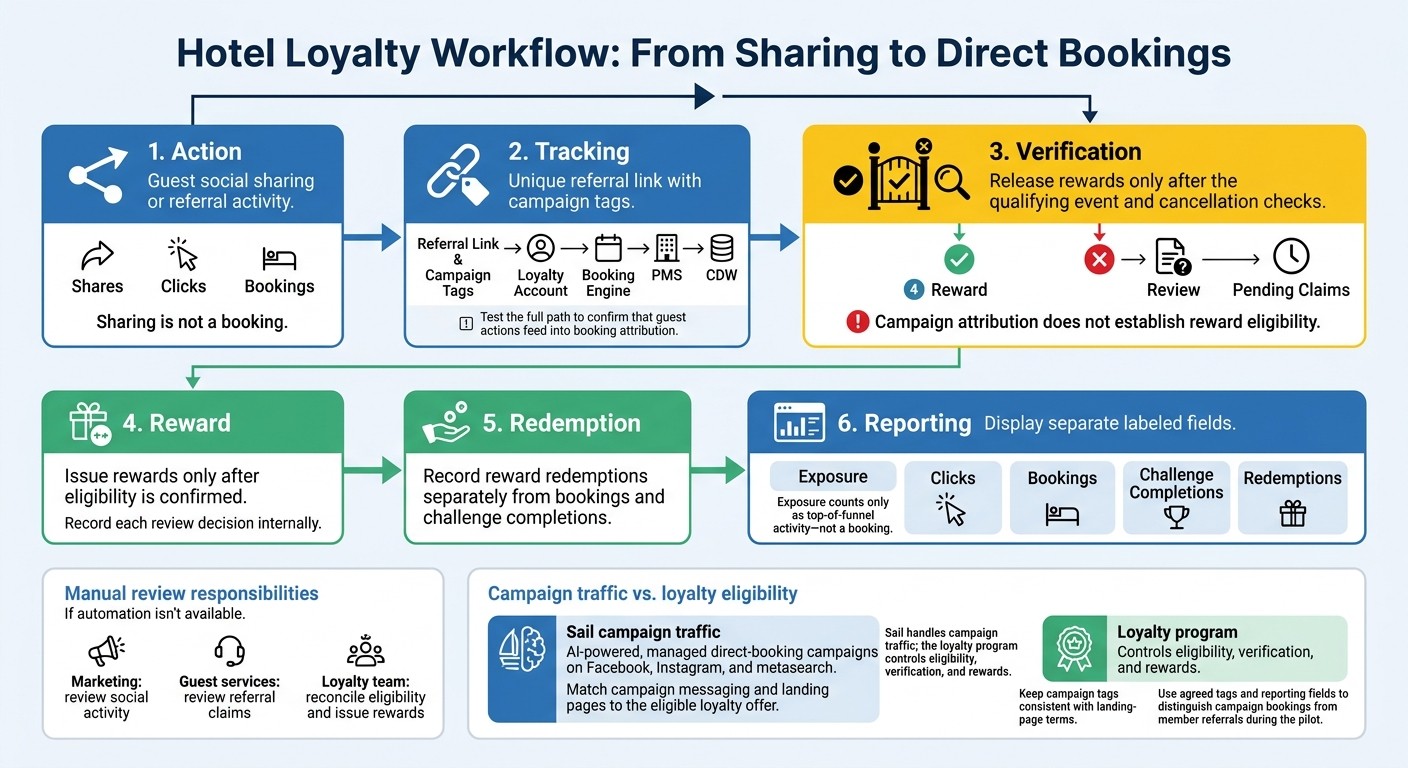
Hotel Loyalty Workflow: From Sharing to Direct Bookings
Once the rules are set, connect the loyalty account to the online booking engine, property-management system, and customer-data workflow. Check which systems can pass member IDs, referral links, and campaign tags. Then test the full path to confirm that guest actions feed into booking attribution.
Track Actions and Confirm Reward Eligibility
Follow one workflow: action → tracking → verification → reward → redemption → reporting. Give each referral its own link and use campaign tags to connect traffic with bookings. Keep personal data out of public links. Instead, use an internal ID tied to the member account.
Treat shares, clicks, and bookings as separate funnel steps. Record exposure, clicks, bookings, challenge completions, and redemptions in separate fields. Exposure counts only as top-of-funnel activity - not a booking.
Release rewards only after the qualifying event and cancellation checks. If automation isn't available, marketing should review social activity, guest services should review referral claims, and the loyalty team should reconcile eligibility and issue rewards. Record each review decision internally.
Align Loyalty Offers With Sail Campaigns
Sail supports direct-booking marketing through AI-powered, managed campaigns on Facebook, Instagram, and metasearch. Match campaign messaging and landing pages to the eligible loyalty offer. Sail handles campaign traffic; the loyalty program controls eligibility, verification, and rewards.
Keep campaign tags consistent with landing-page terms, and agree on the reporting fields. During the pilot, use those tags and fields to distinguish campaign bookings from member referrals. This data is essential for refining strategies to increase direct hotel bookings over time.
Run a Pilot and Measure Results
Once tracking and eligibility rules are in place, test a small pilot before scaling. Start with one property, one guest segment, or one seasonal challenge. Keep the first test focused: one share challenge, one reward, and one booking path. Set a reward budget and a verification limit before launch. Check comments and posts for signs of fraud or negative feedback.
Measure Participation and Booking Results Separately
Report participation, social sharing, and financial results in separate fields. Use these metrics to track what guests do and whether that activity leads to bookings.
Area | Metric | Definition | Data source | Decision use |
|---|---|---|---|---|
Participation | Active users / log-ins | Members active on the platform | Loyalty app/web logs | Reach |
Participation | Task completion rate | Percentage completing the share challenge | Gamification engine | Difficulty |
Social sharing | Engagement rate | Likes, shares, and comments from members | Social media analytics | Engagement |
Social sharing | Referral growth | New members or bookings from social referral links | Referral tracking software | Referrals |
Direct bookings | Conversion rate | Percentage of members completing a direct booking | Booking engine / CRM | Conversion |
Direct bookings | Direct-booking revenue | Revenue from social-linked bookings | Booking engine | Revenue |
Direct bookings | Revenue per member | Revenue divided by participating members | Financial records | Value per member |
Cost efficiency | Incremental CAC | Reward and technology costs divided by new bookings acquired | Marketing budget / CRM | Unit economics |
Retention | Redemption rate | Percentage of earned rewards or social-exclusive offers claimed | Loyalty database | Redemption |
Retention | Retention rate | Percentage of participants making repeat stays | Property management system | Retention |
Churn | Unsubscribe rate | Percentage of members opting out of communications | Email/SMS platform | Churn |
Use the same measurement window for participants and the comparison group. Attribution alone doesn’t prove incremental lift. Compare participants with a similar group of non-participants; random assignment reduces selection bias. Without a control group, use a pre-pilot baseline and account for seasonality and other offers.
Adjust Rewards and Keep Costs in Check
Change one variable at a time: reward value, challenge length, required action, or public vs. private participation. Alongside performance, watch guest feedback, suspected fraud, unredeemed reward obligations, and staff workload. Simplify confusing steps in the next round.
Count rewards, setup, campaign spending, and staff time in pilot costs. Compare those costs with the incremental contribution from direct hotel bookings driven by social sharing after variable stay costs, rather than revenue alone. Scale only when social sharing improves direct bookings and the return covers costs and workload. Otherwise, revise the challenge or stop it.
Conclusion: Start With One Measurable Challenge
Start with one measurable challenge tied to direct bookings. Test it with a small pilot group, one deadline, and one reward linked to the action. Make sharing optional to encourage loyalty participation. Let guests track their progress through a private dashboard or app view.
Before launch, publish eligibility requirements, reward limits, verification steps, data use, and disclosure rules. Expand only when both engagement and incremental direct bookings improve. Reward cost and staff time should guide that decision - not engagement alone. The goal is more engaged members who book direct.
FAQs
Which rewards motivate guests without hurting hotel margins?
Reward guests with experiences and personal touches, rather than costly discounts or free nights. Low-cost perks like late checkout, priority service, or exclusive local experiences - such as a cooking class with a chef - can feel like a big bonus without cutting into profits.
Use guest data to tailor rewards, whether that means complimentary wine or a preferred room type. These personal touches build emotional connections, encourage repeat bookings, and help lower the cost of attracting new guests.
How long should I run a loyalty pilot?
A loyalty pilot has no fixed duration. Instead of setting a strict timeline, focus on collecting feedback and performance data from your pilot group.
Track key performance indicators (KPIs), including active users, conversion rates, and session duration, to measure the pilot’s impact. Keep monitoring these metrics and user behavior, then use what you learn to refine the program around your business goals.
How can guests with private accounts join sharing challenges?
The search results don’t explain how guests with private social media accounts can join sharing challenges. They discuss how social sharing and gamification can help loyalty programs, but don’t address privacy settings or technical workarounds for restricted accounts.
Related Blog Posts
Share:
20 years of hospitality lessons. No fluff. No spam
Join 500+ hospitality pros getting our best growth playbooks.

hi@sailtech.ai
RESOURCES
Products
Free Tools
© 2026 Sail. All rights reserved.