
Blog /
Marketing Strategy
Step-by-step checklist to launch profitable, data-driven hotel loyalty programs: data mapping, privacy, rewards, testing, and KPI reviews.
By Shahar Rubin, Co-founder

I measure hotel loyalty by repeat stays, direct bookings, and profit - not enrollment alone. Before launch, I’d assign owners, check guest records, and test consent, points, and redemption from start to finish.
My checklist covers six steps:
Set goals: Define baseline metrics, targets, reward budgets, and review dates.
Connect guest data: Map systems, resolve duplicate profiles, and check stay and spending records.
Protect member data: Review privacy rules, separate marketing permissions, and test access and deletion requests.
Plan rewards: Group members by behavior, publish clear rules, and compare reward costs with expected profit.
Test before launch: Run a pilot, train staff, and block launch if balances, consent records, or booking flows fail.
Measure results: Check direct-booking revenue, retention, and profit monthly, with a 30-day review after launch.
My rule: <u>prove the program works before expanding it</u>. That means rewards your team can deliver, messages guests have agreed to receive, and growth measured after reward and campaign costs.
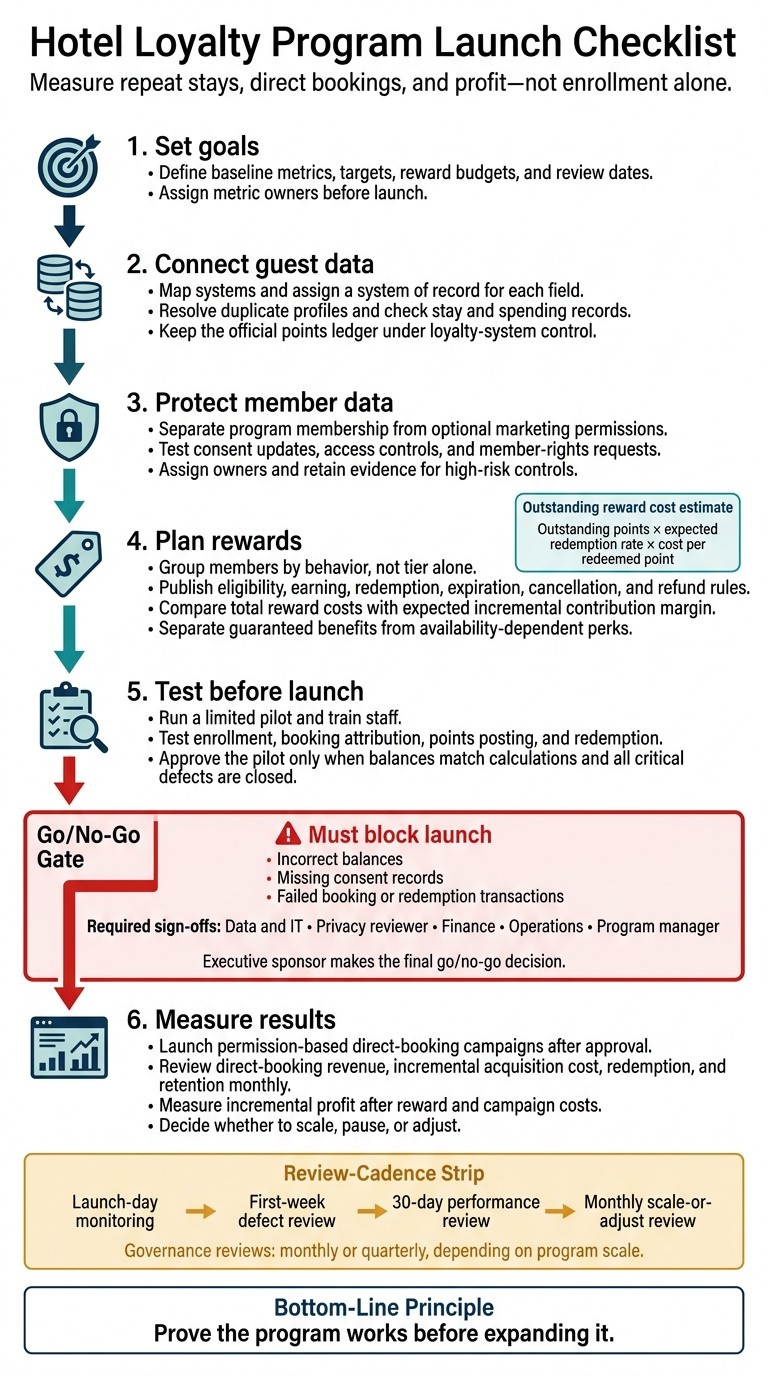
Hotel Loyalty Program Launch Checklist
Top Hospitality Loyalty Program Strategies to Keep Guests Coming Back
Connect Systems and Check Guest Data
Before launch, the designated program and data owners should review the full guest-data stack. The goal: accurate enrollment, reward eligibility, and direct-booking attribution without duplicate records, misfired offers, or missed rewards.
The operations lead and system administrators should check the system inventory, field definitions, and sample records. Their review pack should include the inventory, data dictionary, data-flow diagram, sample records, unified profiles, field mappings, error logs, permissions, and reconciliation results.
Map Data Sources and Update Rules
Inventory the PMS, CRS, booking engine, CRM/CDP, loyalty platform, POS, housekeeping or service systems, guest-feedback tools, email and SMS platforms, website analytics, and OTA channels. Document how each field moves through these systems, and assign each source to one system of record before setting profile rules.
Required attribute | Source system | Business owner | Update frequency | Permitted use |
|---|---|---|---|---|
Member ID and tier | Loyalty platform | Loyalty | Real time after qualifying activity | Benefit eligibility |
Reservation and stay status | PMS/CRS | Reservations | Real time or scheduled | Stay qualification |
Direct-booking channel | Booking engine/CRS | Revenue | Per reservation | Channel attribution |
Room and property preference | PMS/CRM | Guest Experience | After each stay or confirmed change | Service personalization |
Room, dining, and spa spend | POS | Finance | Daily settlement or near real time | Qualifying-spend calculations |
Email and SMS permission | CRM or consent platform | Marketing Privacy | Immediately after consent change | Permission-based communications |
Survey score and service issue | Feedback platform/CRM | Quality | After submission or case resolution | Service recovery |
Points balance and redemption | Loyalty engine | Loyalty Ops | Real time | Reward redemption |
Collect only what you need to enroll members, recognize guests, personalize offers, calculate rewards, or provide service. Keep full payment-card numbers, security codes, passport scans, and other sensitive payment details out of loyalty profiles. Retain only a payment-token reference or transaction identifier when needed to run the service.
For each field, the data dictionary should specify its format, owner, source, meaning, allowed values, and retention period. Treat null, unknown, declined, and not applicable as separate values. Use a standard internal date format, store timestamps with a time zone, and specify whether spend means gross charge, net charge, tax-inclusive charge, or eligible charge.
The CRM/CDP can assemble profiles and send approved segments to marketing tools, but it must not change the official points ledger. Once the sources are mapped, define the matching and merge rules that bring guest records together.
Combine and Test Guest Profiles
Use a stable internal member ID, and keep source-system IDs so teams can trace each record. Start with exact matches, such as a loyalty number or verified email address. Use secondary attributes only when match confidence is high. Never merge records based on matching names alone.
Manually review shared emails and uncertain matches. Flag OTA masked emails rather than treating them as permanent marketing contacts.
Bring stay history, spending, preferences, loyalty status, and feedback under the same identity. Set conflict rules so verified, recently updated values take priority over older or unverified ones. Completed stays should update the guest’s history, and refunds should reverse the related qualifying spend and points.
Keep merge logs and test an unmerge procedure. It must restore profiles, reverse points or stays assigned to the wrong guest, and correct misassigned rewards.
Before approving unified profiles, test data completeness, accuracy, consistency, timeliness, and uniqueness. Cover direct bookings, OTA reservations, cancellations, refunds, split folios, group bookings, and shared-email cases.
Before moving to privacy and data-control checks, require the operations lead to confirm that the setup supports front-desk recognition, qualifying stays, service recovery, and reward redemption. System administrators should also verify interfaces, error handling, access controls, monitoring, and recovery procedures.
Set Privacy and Data Controls
Once unified guest profiles are in place, set privacy and access rules before launch. These controls protect the data used for enrollment, personalization, and direct-booking attribution.
Assign a privacy lead and legal counsel before using guest data for loyalty enrollment, personalization, or marketing. Check the privacy notice, consent records, and access lists against federal, state, payment-card, and industry-specific rules.
Build a state-by-state compliance matrix covering privacy laws, breach-notification requirements, and marketing-consent rules. Have counsel confirm which rules apply based on the hotel’s size, data practices, locations, vendors, and marketing channels.
Document Permissions and Member Rights
Explain what data the hotel collects, why it uses it, who receives it, how long it keeps it, and how members can exercise their applicable rights. Keep program-related uses separate from optional marketing.
Use separate, unchecked opt-ins for program membership, email, SMS, push, personalized ads, and third-party sharing. Don’t require unrelated promotional consent to join unless counsel confirms that it’s lawful and clearly disclosed.
For each permission, log the timestamp, collection channel, notice version, consent language, messaging channel, and withdrawal event. Test whether opt-outs reach the CRM, email platform, SMS provider, booking engine, and advertising tools within a defined service-level target.
Give members an authenticated channel to request access, correction, deletion, portability, sale/sharing opt-out, use limits, and consent withdrawal. Set verification steps and response deadlines, and name an escalation owner.
If a California loyalty benefit depends on collecting, retaining, selling, or sharing personal information, have counsel review the required disclosures and opt-in rules. The notice should explain the benefit, material terms, enrollment and opt-out methods, and how the incentive relates to the data’s value. Covered financial-incentive programs require prior opt-in.
With permissions defined, restrict who can view, export, or share guest data.
Test Data Access and Protection Procedures
Use least-privilege, role-based access. Front-desk staff need reservation and stay data. Marketers need segments - not payment-card data. Require separate privileged accounts, ban shared credentials, and investigate dormant accounts.
Inventory every processor, franchise partner, ad platform, and analytics vendor that receives guest data. Check vendor contracts for permitted purposes, data categories, confidentiality, security controls, subcontractor approval, and help with rights requests. Contracts should also cover deletion or return at termination, breach-notification deadlines, audit or assessment rights, and limits on using hotel data for the vendor’s own advertising.
Require independent assessments, penetration-test summaries, security questionnaires, incident-response contacts, and insurance.
Risk | Control | Owner | Verification method |
|---|---|---|---|
Marketing sent without valid permission | Separate enrollment and marketing permissions; synchronized suppression lists | CRM manager | Sample 25 recent enrollments and opt-outs; confirm consent fields and suppression across systems |
Employee or vendor access without permission | Role-based access, multifactor authentication, quarterly reviews, prompt offboarding | IT/security lead | Review access reports, test terminated-user removal, and inspect privileged-account logs |
Data retained too long | Category-based retention schedule and automated deletion or anonymization | Privacy lead | Run a quarterly aged-record report and verify deletion tickets and vendor confirmations |
Conflicting guest profiles | Matching rules, manual review for uncertain matches, correction workflow | Data steward | Test duplicate, merged, and corrected profiles; confirm points and consent history remain accurate |
Delayed breach response | Incident playbook, escalation tree, evidence preservation, account-recovery process | Security lead | Conduct a tabletop exercise and record containment, notification, and recovery times |
Unverified vendor safeguards | Contractual privacy and security terms plus annual review | Procurement/legal owner | Inspect contracts, assessments, subprocessors, and open remediation items |
Test a member’s correction and deletion request from start to finish in a nonproduction environment. Confirm that changes reach the CRM, loyalty ledger, booking system, marketing tools, backups, and vendor systems.
Keep consent logs, access-review reports, deletion tickets, vendor assessments, test results, training records, and incident exercises as audit evidence. Don’t launch until each high-risk control has a named owner, documented evidence, a successful test, and a remediation date for any failure. Review controls quarterly and after major system changes.
Group Members and Define Rewards
Once profiles and permissions are in place, use the data to build member segments and reward rules. Marketing, revenue management, finance, and operations should review guest profiles, stay patterns, reward costs, and service capacity together. Each segment needs a clear goal, a measurable behavior, and a reward the hotel can reliably deliver. The aim is profitable direct bookings, not just a large audience.
Define Member Segments and Message Triggers
Group members by recency, stay volume, spend, length of stay, booking channel, on-property spend, and reward activity. Keep segment IDs stable for reporting, but update membership as behavior changes. Tier alone is not enough: high-tier members can generate less revenue than lower-tier members.
For each message trigger, document the event, audience, timing, channel, offer, suppression rule, and success metric. This keeps messages tied to guest behavior. Include enrollment, first stay, post-stay follow-up, inactivity, tier progression, and reward expiration.
Set inactivity thresholds based on each segment’s booking cycle. Stop reminders once a member converts, and cap contact:
Limit promotional emails to two per week and active offers to one per member.
Use these segments to choose rewards the hotel can deliver at a known cost.
Set Reward Costs and Eligibility
Match benefits to recorded guest preferences and the hotel’s capacity to deliver them. Operations should confirm availability for breakfast, upgrades, and late checkout. Revenue management should assess peak-demand limits and displaced room revenue.
Publish clear rules for eligible spend, earning rates, qualifying channels, redemption availability, expiration, tier thresholds, exclusions, offer stacking, cancellations, refunds, and partial redemptions. Separate guaranteed benefits from perks that depend on availability.
Finance should model reward delivery, labor, servicing, partner fees, and inventory displacement in U.S. dollars. Compare the total cost with expected incremental contribution margin. Estimate outstanding reward costs using:
Outstanding points × expected redemption rate × cost per redeemed point
Track liability monthly and cap reward cost per incremental booking. Before launch, require marketing, revenue management, finance, and operations to approve segment logic, eligibility rules, and fulfillment.
Test, Launch, and Measure the Program
Test Enrollment, Rewards, and Staff Procedures
Once profiles, permissions, and rewards are defined, run a limited pilot before the full launch. Test enrollment, booking attribution, points posting, and redemption, along with duplicate profiles and failed updates. Carry the results into the profit review.
Approve the pilot only when balances match calculations and all critical defects are closed. Operations must confirm staff readiness, finance must approve calculations, marketing must approve messages and tracking, and the program lead must approve the phased rollout.
Launch Permission-Based Direct-Booking Campaigns
Before sending campaigns, verify consent for each channel and test unsubscribe flows. Make sure suppression lists reach every campaign destination, and check direct-booking links and attribution. Resolve duplicate profiles and flag OTA alias emails before expanding the audience.
If you use Sail for paid acquisition, its pay-per-stay model funds upfront ad spend and charges hotels only after a completed stay. Review billing terms and data permissions before launch.
Track KPIs and Incremental Profit
Have the metric owners assigned earlier review performance after launch. Track reach, conversion, unit economics, redemption, and retention:
KPI | Data source | Decision use |
|---|---|---|
Active users/logins | Loyalty app/web logs | Reach |
Offer completion rate | Loyalty database / CRM | Offer effectiveness |
Conversion rate | Booking engine / CRM | Conversion |
Direct-booking revenue | Booking engine | Revenue |
Incremental acquisition cost | Marketing budget / CRM | Unit economics |
Redemption rate | Loyalty database | Redemption |
Retention rate | PMS | Retention |
Set a monthly scale-or-adjust review using direct-booking revenue, incremental acquisition cost, redemption, and retention. Review incremental profit after reward and campaign costs to decide whether to scale, pause, or adjust.
Conclusion: Confirm Launch Readiness
Resolve Launch Blockers and Schedule Reviews
Maintain a launch-blocker register that tracks severity, impact, owner, corrective action, due date, and sign-off status. Incorrect balances, missing consent records, and failed booking or redemption transactions must block launch. Once owners sign off, the executive sponsor makes the final go/no-go decision.
Use one signed readiness checklist:
Data and IT: Certify reconciled guest records, integrations, dashboard access, and incident escalation contacts.
Privacy reviewer: Approve notices, permissions, access controls, and tested member-rights procedures.
Finance: Approve reward eligibility, calculations, costs, liability, and the baseline for incremental profit.
Operations: Confirm staff can handle routine tasks and escalate exceptions without IT help.
Program manager: Record approvals, assign backup owners, and keep unresolved issues visible.
Schedule launch-day monitoring, a first-week defect review, and a 30-day performance review. Then hold monthly or quarterly governance reviews, depending on program scale.
At every review, check data-quality exceptions, member feedback, redemption and reward costs, consent and suppression failures, direct-booking shifts, and incremental profit. Keep the checklist versioned so owners can document findings, corrective actions, deadlines, and formal closure for each open item.
FAQs
How can I tell if loyalty rewards drive additional bookings?
Measure incremental profit, not just total bookings. Run a holdout test by randomly excluding 10% of eligible guests from loyalty offers. Over 6 to 12 months, compare completed-stay revenue between guests who receive offers (the treatment group) and the holdout group.
Calculate incremental impact with this formula:
(Completed-stay revenue per member − completed-stay revenue per matched non-member) × number of members
Count only completed stays so cancellations don’t inflate the results.
How much guest data do I need to start?
Small hotels don’t need years of guest data to start an AI-powered loyalty program. You can use data already in your property management system and booking engine. Connect your booking, stay, and CRM records, but keep the starting scope small.
Test one guest segment, one perk, and one AI task that staff review. Use the test to set a profit baseline and check results before expanding the program or collecting more data.
How can I reward guests without eroding profit?
Focus on low-cost perks guests care about, like late checkout or priority service, rather than costly discounts or free nights. Use guest preferences stored in your property management system to tailor rewards, build emotional connections, and encourage repeat bookings.
Check your margins by factoring in delivery costs and revenue you might lose by offering each reward. Before expanding the program, confirm that added profit from completed stays exceeds the combined cost of rewards, campaigns, and staff time.
Related Blog Posts
Share:
20 years of hospitality lessons. No fluff. No spam
Join 500+ hospitality pros getting our best growth playbooks.

hi@sailtech.ai
36 East 31st Street, New York, NY 10016
© 2026 Sail. All rights reserved.